Food & nutrition
Feeding Adult Cats
Work through an illustrative calorie calculation, read the energy information on the food label, and adjust portions to your cat’s body condition.
By PettyCatty Editorial Team · Updated 30 September 2026
PettyCatty perspective
Treat a calorie calculation as a starting estimate. The practical check is whether the cat’s body condition and weight trend stay appropriate over time, with every meal and treat included in the daily total.
What to check
A food label gives calories for a specific product, while an individual cat’s needs vary. Discuss a target weight and adjustment interval with a veterinarian before making a large change.
Overview
Any serving-size estimate is a starting point. This guide focuses on adult cats; kittens need a separate growth-stage feeding plan.
There’s no one-size-fits-all chart that says, “If your cat weighs this much, feed her that amount.” Cats are individuals. Some are big but lean, others are small but chunky. They may be young or old, male or female, energetic or laid-back—you get the idea.
Creating a simple portion chart becomes even more complicated with homemade food, as results vary depending on the type of meat you use and how closely you follow the recipe. Some people use lean poultry; others use fatty beef. Naturally, fatty beef is more filling and calorie-dense than the same volume of lean turkey. Some add extra water, increasing volume without increasing calories, while others skip the water entirely—then wonder why their cat is gaining weight on such a small amount of food.
If you want a formula-based approach to determine how much to feed your cat, here’s how veterinary professionals estimate a cat’s daily food portion based on caloric needs.
Step 1: Know the Essentials
- Your cat’s body weight in kilograms.
- The calorie content of the actual food. The worked example below uses a hypothetical food containing 140 kcal per 100 g.
Step 2: Calculate Resting Energy Requirement (RER)
A commonly used estimate of resting energy requirement is RER = 70 × body weight in kilograms raised to the power of 0.75.
For a 4 kg cat: 70 × 4^0.75 ≈ 198 kcal per day. This is a calculation example, not an individual feeding prescription.
Step 3: Calculate Daily Energy Requirement (DER)
Daily energy needs can differ from resting needs. A veterinarian can help choose a starting factor using body condition, activity, neuter status and health.
For illustration, applying a factor of 1.2 to the 4 kg example gives 198 × 1.2 ≈ 238 kcal per day.
- Review the estimate against the cat’s weight and body condition over time.
- Obesity, weight loss, pregnancy and medical conditions require an individual plan; do not use this example to set a calorie restriction.
Step 4: Convert Calories to Grams of Food
Daily grams = daily calorie target ÷ calories per gram. A food labelled 140 kcal per 100 g supplies 1.4 kcal per gram.
In this example: 238 ÷ 1.4 ≈ 170 g per day. A different food or calorie target gives a different portion. Count treats and other foods within the daily total.
Step 5: Divide into Meals
Finishing a meal quickly or begging does not by itself show whether the portion is appropriate. Compare the feeding record with body condition and weight; a persistent change in hunger or appetite deserves veterinary advice.
Portion size should be guided by body condition, not behaviour. If your cat starts losing weight for no clear reason, do consult your vet. It’s especially tricky to monitor food intake in cats who roam outdoors. They might regurgitate food somewhere you can’t see it, catch and eat prey (which adds calories and increases the risk of intestinal parasites), or they may be getting second dinners from friendly neighbours. Outdoor cats often cover long distances, which uses up more calories, but they may also scavenge rubbish or sneak into kitchens.
Many cats prefer several small meals. Divide the agreed daily quantity into a schedule that suits your cat and household, keeping the total consistent. Use a measured feeder if that helps provide smaller meals while you are away.
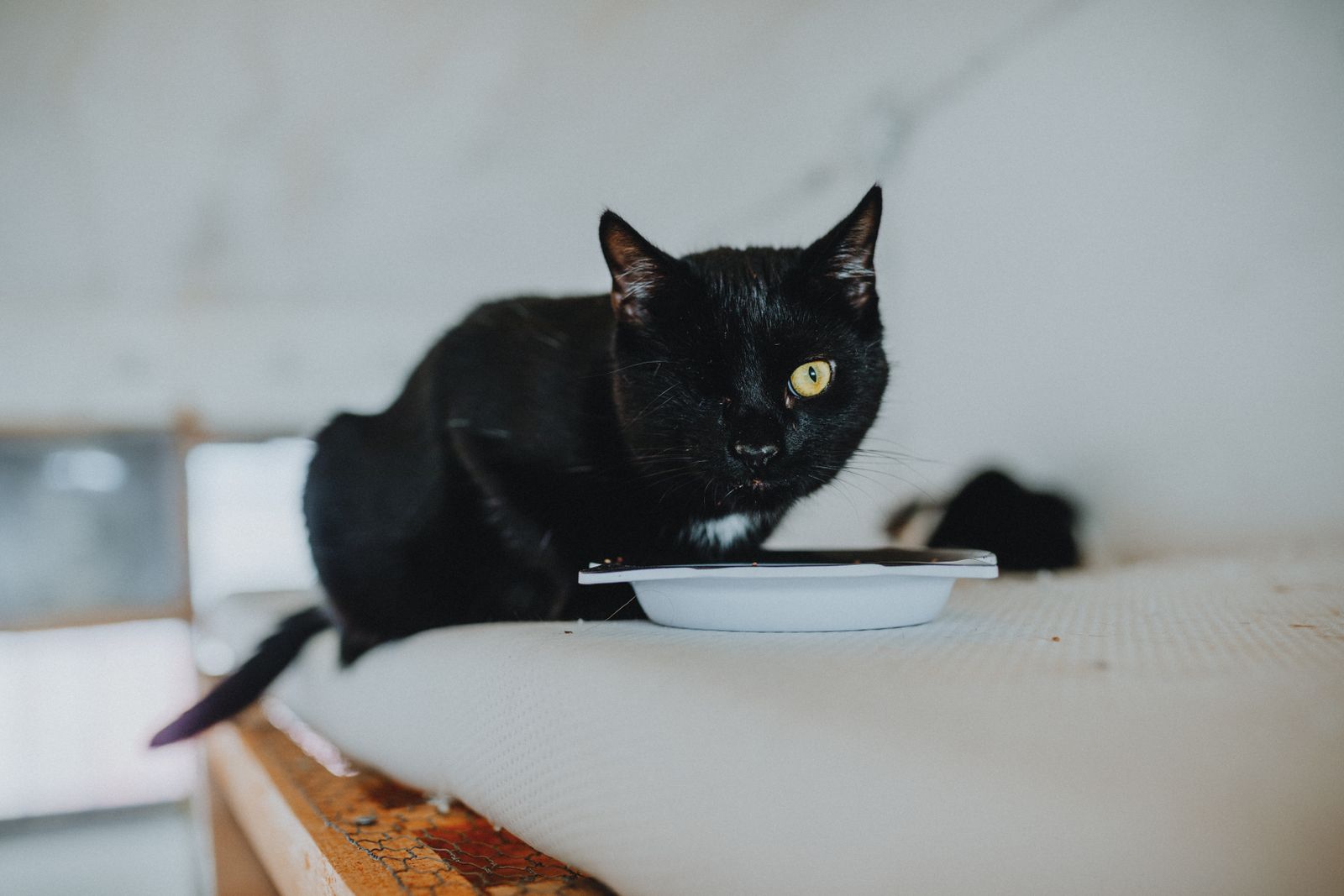
Some cats prefer a wide, shallow dish. Observe whether the bowl and meal size suit your cat rather than assuming one dish or serving size prevents digestive problems. Repeated vomiting or regurgitation needs veterinary assessment.
Young cats can be very food-obsessed. They may climb you while you’re dishing up, leap into the fridge, or appear at the first rustle of a sandwich wrapper. That said, every cat is different. Some remain excited about food their entire lives, while others seem indifferent and need encouragement to eat—even as kittens. A cat’s relationship with food is influenced not just by personality, but by early life experiences. Things like competition from littermates, the kind of food offered, and how often it was fed all shape their lifelong eating habits. Your cat’s eating behaviour also reflects how successfully they’ve trained you. Do you offer them a morsel every time you open the fridge, prepare your own meal, or feel guilty at their pleading eyes? If so, you’ve unintentionally reinforced the begging. A rewarded behaviour is a repeated behaviour—even if the reward was unintentional.
If you find begging intolerable, start early and be consistent: Feed your cat in a quiet, designated place (not the kitchen or dining room), so they don’t associate those areas with food. Feed them the amount they need to maintain body weight, split into three meals—morning, evening, and bedtime works well. Avoid giving tidbits from your plate or fridge. Offer treats away from your own eating spaces, and make sure groceries and rubbish are out of reach.
If your cat is allowed in the kitchen or on counters, it’s up to you to keep food out of reach. If your cat succeeds in stealing food, they’ll keep trying. They’re not daft, and instinct will always win over politeness.
If your cat regularly regurgitates, ask your veterinarian to investigate the cause. Smaller, slower meals may be part of the plan, but a universal gram limit cannot prevent every cause of regurgitation.
- Two meals in the worked example: approximately 85 g each.
- Three meals in the worked example: approximately 57 g each.