
Cat breed profile
Bengal
Known for their exotic looks yet attentive and loving nature, the Bengal is one of the most recognized breeds of cat.
By PettyCatty Editorial Team · Updated 30 September 2026
Choosing this breed
Prioritise climbing, puzzle feeding and play when evaluating this active breed.
What to check
Is your home prepared for a cat that may keep seeking challenges after a short play session?
At a glance
Known for their exotic looks yet attentive and loving nature, the Bengal is one of the most recognized breeds of cat. Bengals are very social and people-oriented and thrive in the company of other people. Find out more about this breed and if a Bengal is right for you and your family.
About the breed
Known for their inquisitive, spirited, loving nature and striking appearance, Bengal cats are one of TICA’s most popular breeds. Breeders developed them from crossing domestic cats with the leopard cat (Prionailurus bengalensis), a small wildcat native to Asian forests, to combine a wild look with the gentle temperament of a domestic cat. With its soft, pelt-like coat featuring dramatic rosettes or distinctive marbling, this unique breed is the only domestic breed with rosettes reminiscent of the breathtaking patterns seen on wild cats worldwide. While all Bengals are heavily muscled, they vary in size and weight based on gender.
Breeders breed modern Bengal cats exclusively from Bengal-to-Bengal pairings, and they thrive in homes prioritizing enrichment and attention to their high-energy personalities. Bengals are generally confident, curious, and devoted companions. Some are extroverted and busy; others are introverted by instinct and prefer a quieter life. But all are loving and communicative with the people in their circle of trust. With proper introductions, they coexist harmoniously with other pets and enjoy being an active part of family life.
Those seeking the engaging interaction and lively companionship of a high-energy, intelligent cat breed will find Bengals a rewarding choice.
Breed standard
The goal of the Bengal breeding program is to create a domestic cat that has physical features distinctive to the small forest-dwelling wildcats, along with the loving, dependable temperament of the domestic cat. With this goal in mind, judges give special merit to the characteristics in the Bengal’s appearance that are distinct from those found in other domestic cat breeds. A Bengal cat is an athletic animal, alert to its surroundings; a friendly, curious, confident cat with strength, agility, balance and grace.
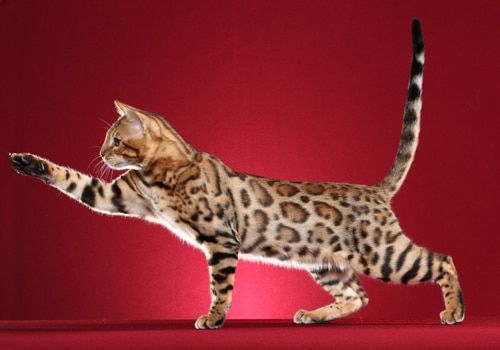
It is a medium to large cat that exhibits a very muscular and solid build. Its wide nose with prominent whisker pads, and large oval, almost round eyes in a slightly small head, enhance the wild appearance and expressive nocturnal look. Its very slight, to nearly straight, concave profile and relatively short ears with wide base and rounded tips add to the Bengal’s distinctive and unique appearance. The short, dense coat has a uniquely soft and silky feel. The coat may be glittered or not glittered; neither type is preferred over the other. A thick, low-set, medium-length tail adds balance to the cat.
Activity and home life
Highly intelligent, Bengals rank among the most trainable cat breeds. They eagerly learn tricks such as playing fetch or walking on a harness, especially when motivated by food treats or clicker training. These training sessions not only burn off energy but also strengthen the bond between Bengals and their human companions.
Bengals are a high-energy breed, constantly climbing to high places, exploring their surroundings, and engaging in mentally and physically stimulating play. They thrive on chasing, climbing, and investigating, bringing a dynamic energy to any home. Outlets such as a cat wheel, consistent interactive play sessions, or puzzle toys keep them entertained and satisfied.
Interaction fuels a Bengal’s happiness. They enjoy engaging with their families and often bond well with another cat or a cat-friendly dog as a playmate. When kept as the only pet, Bengals rely on their humans for frequent enrichment and companionship. Their sociable and curious nature makes them thrive in homes that offer plenty of interaction and engagement.
Breed information and care
Known for their inquisitive, spirited, loving nature and striking appearance, Bengal cats are one of TICA’s most popular breeds. Breeders developed them from crossing domestic cats with the leopard cat (Prionailurus bengalensis), a small wildcat native to Asian forests, to combine a wild look with the gentle temperament of a domestic cat.
With its soft, pelt-like coat featuring dramatic rosettes or distinctive marbling, this unique breed is the only domestic breed with rosettes reminiscent of the breathtaking patterns seen on wild cats worldwide. While all Bengals are heavily muscled, they vary in size and weight based on gender.
Throughout history, people have shown a profound fascination with the large and small wild felines that inhabit the jungles and forests of the world. In 1963, Jean S. Mill crossed the domestic cat with the Asian Leopard Cat, a spotted five to twelve pound shy wild cat species from Asia. This was the first effort to use hybrid offspring to create a breed of domestic cat with the loving nature of a favored fireside tabby and the striking look associated with Leopards, Ocelots and Jaguars. The modern Bengal breed traces to cats Mrs. Mill bred beginning in the early 1980’s. The breed’s name references the scientific name of the Asian Leopard Cat, Prionailurus bengalensis. Breeders register the hybrid crosses as Foundation (F1, 2G & 3G) Bengals, which are not eligible for show; only the females are used for breeding.
TICA accepted Bengals as a new breed in 1986, and they gained championship status in 1991. They are now one of the most frequently exhibited breeds in TICA. An enthusiastic group of breeders around the world have successfully fulfilled the goal of creating a docile, civilized house cat that wears the richly patterned coat of the jungle cats and has some of the arresting features that have inspired and aroused humanity for centuries.
While you can train a Bengal to have “good manners,” they are an active, inquisitive cat that loves to be up high. If you don’t like a cat to leave the floor, a Bengal is probably not the right cat for you. Bengals are busy by nature. They are very affectionate and can be a “lap cat” whenever THEY want to be, but in general their idea of fun is playing, chasing, climbing and investigating. When a Bengal is in full play mode, it’s rather like trying to hold on to running water! They’ll often save the cuddle time for when they want to sleep. Many Bengals enjoy water and may join you in brushing your teeth or taking a shower. Some Bengals are vocal while others are more quiet and selective about using their voice.
Bengals will also, in general, ALWAYS want to be where you are. After all, that’s where the action is! And Bengals are all about “The Action.” Given the choice of a static toy and one that does wild, unpredictable things, Bengals will always choose the “wild” one! For individuals or families who enjoy rambunctious, funny, beautiful and dynamic feline companionship, consider the Bengal.
The Bengal is most noted for its luxurious short, soft coat, which may appear in either the spotted or marble pattern. Some Bengal’s coats feature something called glitter, which imparts an iridescent sheen to each hair. The spotted pattern is most associated with the “leopard look,” as the coat features clearly discernible spots and rosettes. The Bengal’s spots can be large or small and often include rosettes – like the spots of Jaguars and Leopards – which are two-toned spots. Bengals may also be marbled, a derivative of the classic or “bull’s eye” pattern found in many breeds of cats, but with an especially dramatic appearance in Bengals. The marbled Bengal has a swirling pattern that appears as random swirls or thick diagonal and horizontal lines flowing across the coat of the cat.
The most popular color of the Bengal is the brown/black tabby, a lackluster description for coats that can range anywhere from a cool grey to vibrant shades of golden, bronze, copper or mahogany, with spots or marbling ranging from rich browns to intense black. Bengals also come in a range of colors associated with a form of albinism, which breeders call “snow,” that indicates Siamese and Burmese ancestry. In these colors, the coat appears ivory, cream or light tan with spots or marbling that may range from light brown to dark chocolate, and the eye color is blue to aqua. Silver Bengals have grey to nearly white backgrounds with dark grey to black patterns. Also distinctive about the Bengal’s coloring is that they may have nearly white undersides and facial markings that still show the tabby pattern.
Bengals are medium to large cats, from 6-15 pounds, with males generally being larger than females. A healthy Bengal is well muscled and has an appearance that depicts its athleticism. Bengals are balanced cats, and none of their physical features should appear exaggerated or especially pronounced.
Bengals are generally confident, curious and devoted companions. They get along well with other pets when properly introduced and enjoy being part of a family. Each Bengal is an individual, and those interested should find out as much as they can about this wonderful breed before adding one to their family.
TICA breeders should test for Hypertrophic Cardiomyopathy (the most common heart disease in all domestic cats), and provide genetic testing for Progressive Retinal Atrophy and PK-deficiency (Erythrocyte Pyruvate Kinase Deficiency). Note: people commonly misdiagnose Bengals with Intestinal Bowel Disease. An appropriate high protein diet and proper testing for parasites can clear any real issues.
Shorthaired Bengals don’t require much grooming, as their short hair results in little shedding. Most cats shed a winter coat in the spring, so brushing with something like a Zoom Groom brush is good. A chew toy helps keep the teeth clean, as do chicken sticks, strips or chunks of meat. We recommend monthly nail trimming.
Longhair Bengals require daily grooming with a comb or brush.
Bengals need a complete diet suited to their life stage. Measure food and monitor body condition, especially after neutering. Raw and freeze-dried raw food can carry pathogens; discuss food choices with your veterinarian.
As with all cats, it is important to give your cat fresh, clean water daily. Fresh, clean water is best, so cats don’t hesitate to drink. If you worry about your cat drinking enough water each day, here’s a tip from some cat behaviorists: place the water bowl at least three feet away from any food. Cats’ noses are sensitive, and an overwhelming smell of food may cause them to drink less. You can also use filtered drinking fountains in place of a water bowl.
Compare a related breed
Abyssinian is worth comparing when the features above appeal to you. Plan for climbing space and daily interactive play; a short coat reduces grooming time but does not replace activity.
Use both profiles as starting points; an individual cat’s behaviour and care needs matter more than a breed average.