
Cat breed profile
Birman
Gentle and affectionate by nature, the Birman has all the makings of a loyal, faithful companion.
By PettyCatty Editorial Team · Updated 30 September 2026
Choosing this breed
A long coat and people-oriented profile call for both grooming and quiet social access.
What to check
Can you maintain coat care without forcing handling when the cat wants space?
At a glance
Gentle and affectionate by nature, the Birman has all the makings of a loyal, faithful companion. They are one of the easiest cats to handle and gives the least cause for trouble. They love to be around people and can adapt to any type of home.They are available in a variety of colors. Their loving and laid back nature has captured the hearts of cat lovers around the world. Find out why and if this breed is right for you ad your family.
About the breed
Curious and outgoing, Birman cats love being introduced to new people and bask in attention and affection. They are an extremely loving and loyal breed. Their friendly, laidback personality is the perfect choice for families with children and cat-friendly dogs. Their low-maintenance and desire for companionship also makes they idea for seniors. If you talk to a Birman they will respond in a soft, pretty voice. More than anything they love being held and relaxing in the arms of their caregiver.
Breed standard
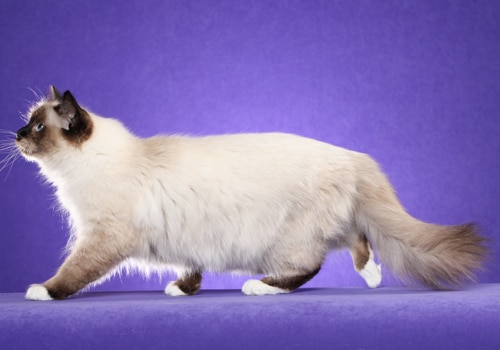
The Sacred Cat of Burma (Birman) is a semi-longhaired pointed cat with white feet. He is imposing in appearance, medium to large in stature, with heavy boning in proportion to size. Females are appreciably smaller than males. The Birman is to be healthy, muscular, and in good balance. The coat has a tendency not to mat or tangle. The Birman is accepted in all pointed colors with distinctive white gloves and laces.
Activity and home life
Affectionately referred to as the “Velcro” cat, the Birman is a quiet cat who loves people and will follow them throughout the day. While considered quieter than some breeds, they have a serious playful side. It’s not unusual for them to fetch or chase a ball when not curled up on the lap of their caregiver. An intelligent and curious breed, they also love to play with interactive toys that require thinking.
Breed information and care
The legendary Birman takes your breath away with its stunning pointed, semi-longhaired coat and bewitching deep sapphire blue eyes. The silky coat is light in color and ideally misted with a golden hue. They have white gloves on all four feet and white laces up the back of their hindlegs contrasting with the main point color. These gentle cats have a stocky build and a powerful musculature-keep them in top condition by indulging their love for play!
The Birman has a lovely legend about being raised by the Kittah priests in their temple in Burma. The story tells of a golden eyed, white cat that stood guard over his dying holy master and was transformed into a cat with a dark brown head, and dark brown legs & tail, but his coat became a cream color with a golden glow from this master’s golden goddess. As the master died and his soul passed on to the cat, the cat’s paws and hocks, where he sat on his master’s chest, stayed pure white as a sign of his master’s purity. As the cat gazed up at the golden goddess, his gold eyes turned to a beautiful sapphire blue, the same as his master’s goddess. There are many versions of the legend, and this is just a very short one.
As for fact, the Birman was first recognized and shown in France in the 1920’s. England then recognized the breed in 1966. The Birman was first imported into the United States in the 1960’s and was recognized and shown in 1967. The Birman breed is now recognized and loved worldwide! This Birman breed has consistently remained in the top ten most favorite cats for many years.
The Birman is a great family cat. It dwells peacefully within a single cat home or a home with many cat friends. With a constant response from his owner when the cat meows, the Birman will become quite a talker. If you prefer just the quietness of his purr, lack of response will discourage the cat from talking. With lots of love, good food, fond grooming, and proper health care, the Birman makes the greatest buddy, friend, confidant, and all around purrfect pet.
The Birman is a medium to medium-large longhaired pointed cat with distinctive white gloves and laces. All four feet have white gloves and the back feet have laces extending about halfway up the back leg.The Birman has a long, soft, almost silky single coat. The thickness will vary with seasonal conditions. This coat is of such that it has a tendency not to mat. With good grooming habits on the part of the owner, stray hairs can be combed out weekly. The combing action can be good together time for cat and owner.
Birmans have a distinctive roman nose that, when viewed in profile, starts at the change of direction at the forehead and rises in a hill-shape that goes down at the end with the nose leather low. The chin has good depth and should not be bulbous or receding. The ears are almost as wide at the base as they are tall. They have good width between them. The eyes are medium to large and moderately round, with good width between. The tail is neither long or short, but in balance with the body. This is checked by gently holding the tail along the back so that it reaches the shoulder blades. The body is long and sturdy. The legs should be well muscled and in good proportion to the body.
Birmans come in all pointed colors. There is a color to match anyone’s desire. They are all beautiful…..they are all BIRMAN.
Birmans are generally healthy and can live up to 15-plus years.However, it is important to follow nutrition suggestions and schedule regular visits to the veterinarian to prolong the health and safety of a Birman.
Despite the length of there coats, Birmans have what is called a “single coat” meaning they do not have an undercoat and are easy to groom.
Brushing them with a metal comb once a week will keep them in top condition. Birmans shed their winter coat in the spring, so you may want to comb more frequently then to remove loose hair.
Keep their nails trimmed, ears cleaned and teeth brushed regularly with a vet-approved pet toothpaste and provide a nice tall scratching pole to help their natural scratching instinct.
Birmans do not have any particular nutritional needs other than good, quality, dry kibble.
As with all cats, it is important to give your cat fresh, clean water daily so they don’t hesitate to drink. If you worry about your cat drinking enough water each day, here’s a tip from some cat behaviorists – place the water bowl at least three feet away from any food. Cats’ noses are sensitive and an overwhelming smell of food may cause them to drink less. Filtered drinking fountains can also be used in place of a water bowl.
Treats can be given in moderation.
Compare a related breed
Ragdoll is worth comparing when the features above appeal to you. The profile emphasises a large, long-coated companion; allow for grooming without assuming every cat likes being held.
Use both profiles as starting points; an individual cat’s behaviour and care needs matter more than a breed average.