
Cat breed profile
Burmese
Burmese are extremely sweet natured, people-oriented cats that love to curl up on any available lap.
By PettyCatty Editorial Team · Updated 30 September 2026
Choosing this breed
The profile describes a sociable cat with a short coat, so the larger commitment is interaction rather than grooming.
What to check
Will the cat have companionship and play on days the household is busy?
At a glance
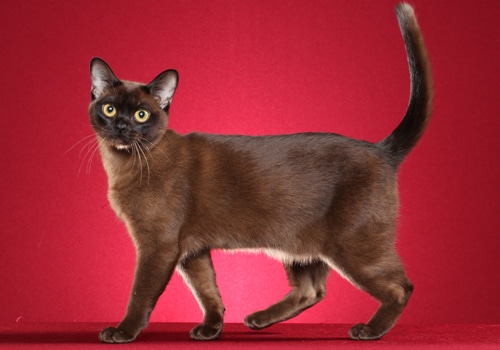
Burmese are extremely sweet natured, people-oriented cats that love to curl up on any available lap. They are extremely people-oriented and tolerant cats that are an ideal pet for the whole family, including younger children. They can be found in a range of solid and tortoiseshell colors. Find out more about this breed and if the Burmese is right for you and your family.
About the breed
A sweet and charming cuddler, the Burmese is an outgoing, people-oriented cat that loves to curl up on any available lap. They are playful cats and their playful nature extends to joining the games of the youngest family members, easily tolerating being dressed up in doll’s clothes and carried around like a living doll. They are very social cats that thrive on the company of others, thus they tend to become lonely if left by themselves for long periods of time. They have a soft voice and enjoy talking with their families about the events of their day.
Breed standard
The overall impression of the ideal Burmese would be a cat of medium size with substantial bone structure, good muscular development and a surprising weight for its size. This together with a rounded head, expressive eyes and a sweet expression presents a totally distinctive cat, which is comparable to no other breed. The Burmese is a cat of perfect physical condition, with excellent muscle tone. There should be no evidence of obesity, paunchiness, weakness, or apathy.
Activity and home life
Highly intelligent, Burmese cats thrive with families who are willing to teach them tricks, play games and provide plenty of puzzle or interactive toys. They do best with families who give them plenty of attention and get along well with children and other pets. They are extremely people-oriented and tolerant cats that are an ideal pet for the whole family, including younger children. The Burmese will happily join in games and play the role of living doll.
Breed information and care
The seal sepia, or sable, Burmese with its rich, short, glossy dark brown coat and deep gold eyes springs to mind when one thinks Burmese. But these compact bundles bring joy and love to your world as they give you complete and unconditional devotion. They are extremely people-oriented and tolerant cats that are an ideal pet for the whole family, including younger children. The Burmese will happily join in games and play the role of living doll. While the sable Burmese is the original color, the Burmese now comes in a variety of other colors from a warm blue to a pinky-grey lilac to a soft chocolate and even combines these colors with red and cream. Imagine a lilac tortoiseshell-a combination of soft pinks mingled with rich cream color of Devonshire clotted cream! These newer colors are rapidly becoming as popular as the original sable brown.
The Burmese, as we know it today, was developed in America from a single cat: Wong Mau. In 1930 a sailor brought Wong Mau from the Orient and gave her to Dr. Joseph G. Thompson of San Francisco. She was described as “a rather small cat, fine-boned, but with a more compact body than that of a Siamese, with a shorter tail, a rounded, short-muzzled head, with greater width between rounded eyes.” She was walnut-brown in color, with darker brown points. Many breeders considered her a dark Siamese but Dr Thomson thought she was distinctly different. He established a program to isolate and reproduce her distinguishing traits. In 1932 Wong Mau was bred to Tai Mau, a Seal Point Siamese, and had kittens of two colors: some like Siamese kittens and others brown kittens with darker points like Wong Mau. Bred to her son, Yen Yen Mau, Wong Mau’s kittens contained 3 colors: some like Siamese kittens, brown kittens like Wong Mau, and some dark brown kittens. The dark brown offspring founded the Burmese breed. It is now accepted that Wong Mau was actually a Siamese x Burmese hybrid.
On Mar 29 1955, the first blue Burmese kitten, Sealcoat Blue Surprise, was born in England. Cats other than sable had appeared earlier, but most Burmese breeders chose to breed only the sable cats. It is now believed that Wong Mau also carried the genes for dilution and chocolate that resulted in the appearance of chocolate, blue and lilac kittens. The red factor was added later in Europe. The Burmese was one of the original breeds TICA recognized in June 1979.
Burmese are extremely sweet-natured, people-oriented cats who love to curl up on any available lap. They are playful cats and their playful nature extends to joining the games of the youngest family members, easily tolerating being dressed up in doll’s clothes and carried around like a living doll. They are very social cats that thrive on company and will be lonely if there is no-one home with them. They are an ideal family pet but if your busy household means they will be alone for long periods of time, you might want to consider two so they will be company for each other.
Burmese come in a range of solid and tortoiseshell colors: rich, dark sable brown; a medium, warm blue; a warm, honey beige chocolate with pink or fawn tints; a lovely lilac that ranges in tone from a bright pinkish grey to a silvery platinum with pink tints; reds of a light, golden apricot with melon-orange overtones; rich, warm deep creams with hints of apricot; and the soft mingling of red or cream with sable, chocolate, blue or lilac found in the tortoiseshells. All with seductive gold eyes glowing with their love for you. In young cats, the points will be darker but as the cat gets older and the coat matures the body color becomes deeper and richer until there is only a very slight difference between it and the color on the legs, head and tail.
The Burmese is a medium-sized, compact cat with a strong, well-muscled body making it surprisingly heavy for its size. It has a short, silky, single coat that hugs the muscular body and is a joy to stroke. The Burmese is a sturdy cat like a little bulldog with females being smaller than the males. The head is rounded and its large, innocent-looking gold eyes give it a sweet expression.
Their satin-like coats require little maintenance. A weekly grooming with a rubber brush to remove loose hairs will polish the coat to a high gloss. The oils from your hand petting and stroking the coat help maintain its balance and a quick wipe with a chamois will give that final finishing touch.
The Burmese has a soft, soft sweet voice and will enjoy a conversation with you if encouraged. These charming cats with rich colors, big gold eyes, and velvet paws will win your heart while you wonder how you ever lived without one in your life.
Hypertrophic cardiomyopathy can occur in cats, including this breed. A normal appearance does not rule out heart disease. Ask your veterinarian whether the individual cat’s history or examination warrants cardiac testing; screening methods and timing should be tailored to the cat.
The satin-like coat of a Burmese requires little maintenance. Weekly grooming with a rubber brush to remove loose hairs will polish their coat to a high gloss. The oils from your hand petting and stroking their coat help maintain its balance. A quick wipe with a chamois cloth will give their coat the final finishing touch.
As with all cats, keep their nails trimmed, ears cleaned and teeth brushed regularly with a vet-approved pet toothpaste and provide a nice tall scratching pole to help their natural scratching instinct.
Exercise and a high-quality diet are key to keeping a Burmese healthy.
As with all cats, it is important to give your cat fresh, clean water daily. Fresh, clean water is best, so cats don’t hesitate to drink. If you worry about your cat drinking enough water each day, here’s a tip from Jackson Galaxy and other cat behaviorists –Place the water bowl at least three feet away from any food. Cats’ noses are sensitive and an overwhelming smell of food may cause them to drink less. Filtered drinking fountains can also be used in place of a water bowl.
Compare a related breed
Bombay is worth comparing when the features above appeal to you. A short coat is simple to manage, while the companionable temperament described here deserves more attention than the black colouring.
Use both profiles as starting points; an individual cat’s behaviour and care needs matter more than a breed average.