
Cat breed profile
Maine Coon
Despite their size, the Maine Coon cat is sweet-tempered, gentle and friendly and gets along with just about everyone.
By PettyCatty Editorial Team · Updated 30 September 2026
Choosing this breed
The large frame and long coat require space and routine coat checks; size alone does not indicate fitness.
What to check
Can you provide suitable furniture and track body condition as the cat matures?
At a glance
Despite their size, the Maine Coon cat is sweet-tempered, gentle and friendly and gets along with just about everyone. They have a clown-like personality and are willing to ‘help’ their owners, yet aren’t demanding of attention. Find out more about this breed and if the Maine Coon is right for you and your family.
About the breed
The Maine Coon is a beautiful and loving cat that you will treasure having in your life.
Social by nature, they make excellent companions for large, active families of all ages that also enjoy having dogs and other animals, including other cats. Despite their size, Maine coons are among the gentlest of cats and tend to follow their people room-to-room as constant companions, if not always lap cats. While sometimes mischievous, Maine Coon antics are good-natured and easily forgiven by adoring owners.
Breed standard
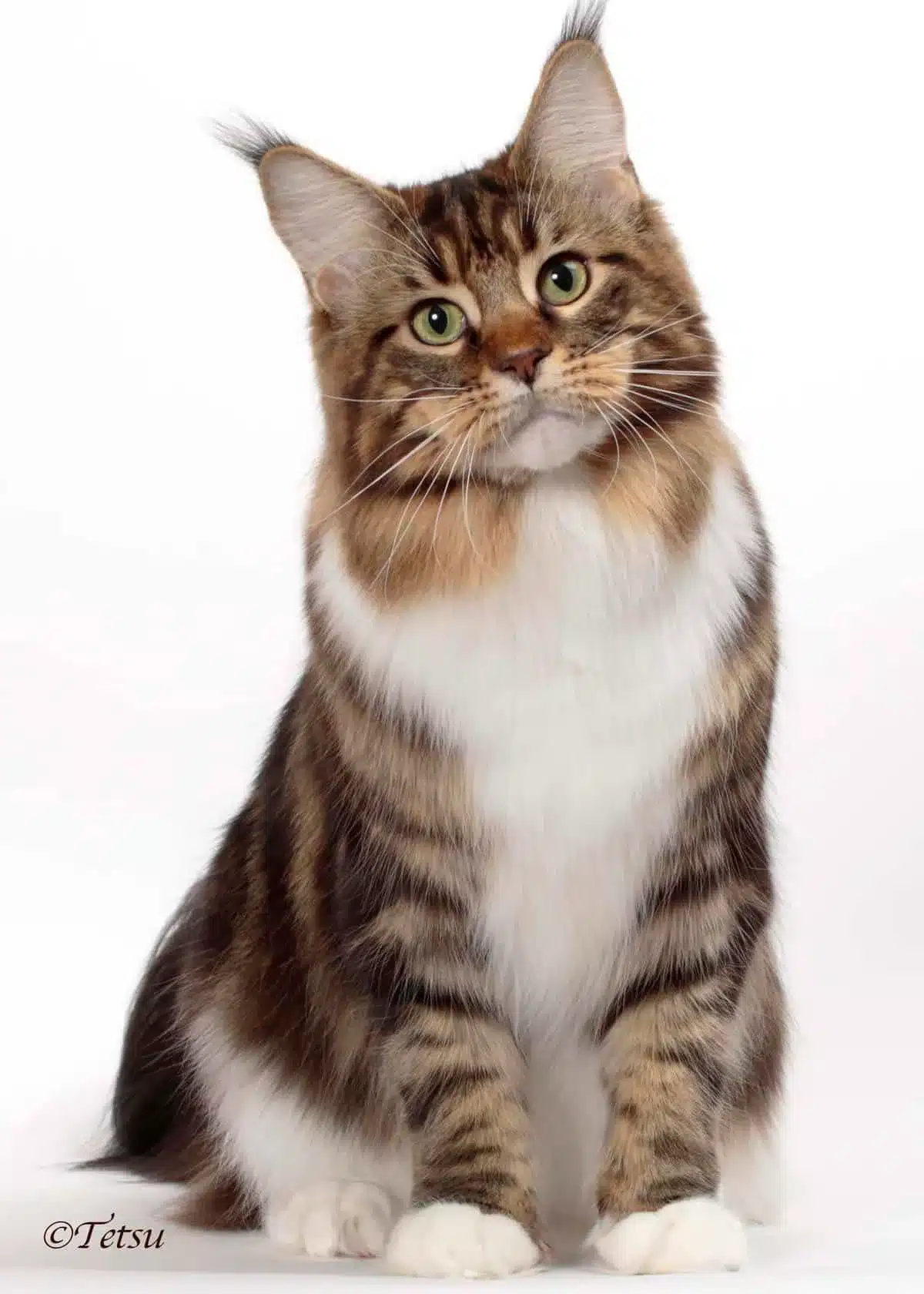
The Maine Coon is America’s native longhaired cat. The breed, with its essentially amiable disposition, developed through a natural selection process where only the fittest survived. It should always be remembered that the Maine Coon developed basically as a “working cat” able to fend for itself in rough, woody terrain and under extreme climatic conditions. The Maine Coon is one of the largest cat breeds with big ears, broad chest, substantial boning, a long, hard-muscled, rectangular body and a long, flowing tail, and large feet with tufts.
Activity and home life
Kittens are of course, more active than their adult counterparts, but if encouraged, most Maine Coons remain playful their whole lives. Interactive toys can provide both exercise and bonding time, while many play fetch, walk on a leash, and entertain their family by following simple commands (for a reward, of course!)
Breed information and care
America’s native longhair, Maine Coons were well established over a century ago as a hardy, handsome breed of domestic cat, well equipped to survive the hostile New England winters. Maine Coon breeders have sought to preserve the Maine Coon’s ‘natural,’ rugged qualities. Maine Coon owners enjoy the breed’s characteristic clown-like personality, affectionate nature, amusing habits and tricks and willingness to ‘help’ with any activity. They make excellent companions for large, active families that also enjoy having dogs and other animals. For owners wishing to show, the Maine Coon has reclaimed its original glory in the show ring.
One of the oldest natural breeds in North America, the Maine Coon is generally regarded as a native of the state of Maine (in fact, the Maine Coon is the official Maine State Cat). A number of attractive legends surround its origin. A wide-spread (though biologically impossible) belief is that it originated from matings between semi-wild, domestic cats and raccoons. This myth, bolstered by the bushy tail and the most common coloring (a raccoon-like brown tabby) led to the adoption of the name ‘Maine Coon. Another popular theory is that the Maine sprang from the six pet cats which Marie Antoinette sent to Wiscasset, Maine when she was planning to escape from France during the French Revolution. Most breeders today believe that the breed originated in matings between pre-existing shorthaired domestic cats and overseas longhairs (perhaps Angora types introduced by New England seamen, or longhairs brought to America by the Vikings).
First recorded in cat literature in 1861 with a mention of a black and white cat named ‘Captain Jenks of the Horse Marines,’ Maine Coons were popular competitors at early cat shows in Boston and New York. A brown tabby female named ‘Cosie’ won Best Cat at the 1895 Madison Square Garden Show.
While Maine Coons are highly people-oriented cats, they are not overly-dependent. They do not constantly pester you for attention, but prefer to “hang out” with their owners, investigating whatever activity you’re involved in and “helping” when they can. Most are not lap cats but Maine Coons will stay close by you, follow you from room to room and wait outside a closed door for you to emerge. A Maine Coon will be your companion, your buddy, your pal, but rarely your baby.
Maine Coons are relaxed and easy-going in just about everything they do. They generally get along well with kids and dogs, as well as other cats. They are not as vertically-oriented as some other breeds, preferring to chase objects on the ground. Many Maine Coons will play “fetch” with their owners. Maine Coons develop slowly, and don’t achieve their full size until they are three to five years old. Their dispositions remain kittenish throughout their lives; they are big, gentle, good-natured goofs. Maine Coons rarely meow, instead most have a soft chirp or trill in a tiny voice doesn’t fit their size!
The important features of the Maine Coon are the head and body shape, and the texture and ‘shag’ of the coat. Maine Coons evolved by adapting to a harsh Northeast climate. Its semi-longhair glossy coat is heavy and water-resistant, longer on the ruff, stomach and britches and shorter on the back and neck. The coat falls smoothly, and needs regular checks for tangles; grooming frequency varies with the individual coat. Maine Coons have very long, bushy tails.
One of their most distinctive features is their eyes, which are large, oval to nearly round, expressive, and set at a slightly oblique angle.
Maine Coons are seen in nearly all traditional colors and patterns. The most common color and pattern is the brown classic or mackerel tabby but Maine Coons are also seen in solid pattern (white, black, blue and red), tortoiseshell pattern (black, blue), tabby pattern (classic or mackerel – brown, blue, red, cream), silver pattern (black-silver, blue-silver, red-silver, cream-silver). All colors (save white) and all patterns may have white markings (known as particolor). Eye color ranges from gold to green. Blue and odd-eyes are permissible in whites and/or particolors.
Maine Coons male cats, at maturity, can average 13-18 lbs. Maine Coon female cats average 9-13 lbs. Overall, the Maine Coon should appear as a large, natural yet uncommonly attractive cat.
Hypertrophic cardiomyopathy is a relevant health consideration for Maine Coons. Tests for known genetic variants and heart ultrasound provide different information; a negative genetic test does not rule out every cause of heart disease. Discuss the individual cat’s screening and family history with a veterinarian.
As a large breed, Maine coons may be susceptible to joint disorders. Many breeders will also test their breeding cats for feline hip dysplasia (Xray) and luxating patella (Xray and/or physical exam). Additionally DNA screening for SMA (spinal muscular atrophy) and pyruvate kinase deficiency is becoming more commonplace by breeders.
The coat of a young kitten tends to be thinner and shorter as compared to that of an adult Maine Coon. The mature Maine Coon has a two-layered coat which is shorter around the shoulder and longer around the underbelly, britches and ruff. Coat type/texture can vary based on the color and/or their ancestral lineage. Some have cottony, high maintenance coats that need daily combing and regular grooming. Others have a silky coat that doesn’t need as much attention. However, regular combing for all coat textures should be started from a kitten age and continued throughout their lives. The Maine Coon loves the attention and grooming, but some find it easier to keep them in a “lion cut” rather than keep up with the daily grooming.
Nails should be trimmed more frequently (once a week) when the Maine Coon is a kitten and less frequently (every 2-3 weeks) as an adult. As with any cat, regular teeth brushing is recommended. Talk to your vet for instructions and suggestions.
Maine Coons need a complete diet appropriate to their life stage. Monitor body condition and measure portions using the calorie information for the actual food. Breed size alone cannot determine a daily cup allowance.
As with all cats, it is important to give your cat fresh, clean water daily so they don’t hesitate to drink. If you worry about your cat drinking enough water each day, here’s a tip from some cat behaviorists – place the water bowl at least three feet away from any food. Cats’ noses are sensitive and an overwhelming smell of food may cause them to drink less. Filtered drinking fountains can also be used in place of a water bowl.
Compare a related breed
Norwegian Forest Cat is worth comparing when the features above appeal to you. A substantial seasonal coat creates a practical grooming commitment even when the cat grooms well alone.
Use both profiles as starting points; an individual cat’s behaviour and care needs matter more than a breed average.